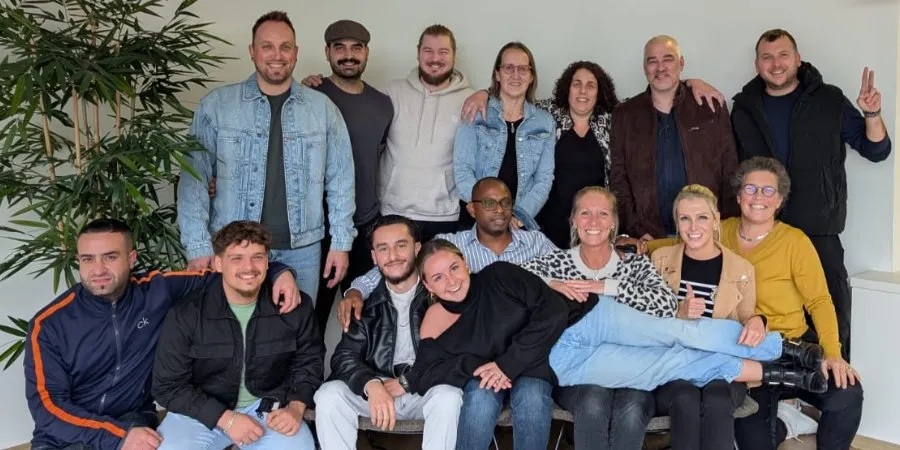
In a warehouse where pace and efficiency set the tone, talking about feelings or tensions does not seem obvious. And yet: it is precisely there that Nonviolent Communication can contribute significantly to collaboration.
At Schoenen Torfs, they have been working with Nonviolent Communication for years, based on the belief that connection in the workplace starts with truly listening and seeing each other as human beings. This is also the experience of Melina Parois, Warehouse Manager and HR Business Partner, who experienced the training firsthand.
In this interview, she explains how colleagues blossom when they feel heard, how leaders grow by being vulnerable, and how collaboration runs more smoothly when there is more understanding and connection between the different levels.
Read the full interview with Melina and discover how Nonviolent Communication is also alive in a production environment at Torfs:
Warehouse Manager & HR Business Partner at Torfs
“As a company, we want to create a safe place where people can be themselves. There are people who are lonely, who carry a heavy burden, and they find a family with us. For me, it is important to see the unique individual, with all their talents. Not just another employee.”
Speaking is Melina Parois, Warehouse Manager & HR Business Partner at Torfs. She once started as a warehouse worker herself and grew into a leadership role and confidential counselor. We spoke with her about the impact of the Nonviolent Communication training, including for the more operational staff.
To start with a challenging question: you sometimes hear “operational staff aren’t interested in those trainings, they’d rather just keep working.” How do you experience that?
“It is sometimes a bit awkward, people don’t always feel like it right away, but during the training, we respond to what is going on from the very first moment. Throughout the day, they loosen up, they find a voice… and you see them blossom. Sincerity and honesty emerge. It remains active—no PowerPoint or sitting still in a chair for a long time—but doing and experiencing. They leave with energy and say: ‘We should actually repeat this with our team every year.’ Afterwards, they also dare to name things more. It really has a lasting effect.”
What works, and what doesn’t?
“We work a lot from practice, sometimes even with private examples. People start sharing spontaneously. They receive tools and insights, but participants immediately apply them to their own examples. By talking about feelings and experiences, mutual understanding and respect grow. It’s like getting to know each other’s manual.”
You put workers, team leaders, assistants, and managers together in the training at the same time. Why that approach?
“In the beginning, we experimented a bit with the group composition until it felt right. The power lies in experiencing this together, away from the work floor. That strengthens solidarity and understanding. Everyone gets the chance to be heard and to grow. Away from the work environment, they are given the space to pause and enter the experience together from all levels and learn from each other. That is what makes this approach so strong.”
And what about managers who say ‘we don’t have time for that’ or ‘if we aren’t there, they will be able to speak more easily’?
“I say: ‘Join them, open up, and listen.’ You hear things you would otherwise never hear: unexpected talents, personal stories… If people are afraid to speak, that is an important signal: what does that say about the working relationship and your own leadership? And what can you do about it?”
Do I also hear an efficiency gain there?
It gives you the opportunity as a manager to name things and be vulnerable. To say honestly, “OK, that could have been done differently… we missed the mark there.” In this way, you also set a good example. In addition, it gives us as managers the chance to set the benchmark and say, “We have already grown in that area,” but also, “We still have room to grow here.” Where possible and useful, the information also flows through to other levels. Everyone learns.”
What stands out for you when you look back on the training sessions?
“The variety, the clarity, the visuals. That works well for our staff and also for managers. There is energy after every session; people feel more connected. There is more solidarity. I would recommend it to every organization: involve all levels, because it is an investment that truly pays off.”
What is the effect after the training?
“People say: ‘We have been seen, we have been heard.’ Deeper contact is made. You understand better why someone reacts the way they do. Sometimes the cause lies in their past. By speaking this out and hearing each other in this, acceptance grows. At the same time, there is room to name things and make agreements. Despite language barriers or cultural differences, everyone belongs. When someone suddenly dares to speak or shows more of themselves, I am truly proud. Everyone steps into their power.”
What does this mean for you as a manager?
“The threshold to approach me becomes lower. That is worth its weight in gold. People dare to be honest, and that also makes me grow. As a company, you create a safe place where people can be themselves. We try to see the person, in all their unique talents. That brings it full circle: you let people grow from their own authenticity.”
Finally, what message would you like to leave us with?
“Try to understand each other. Don’t judge immediately, but step into each other’s shoes and listen. Then we will move toward a different world together.”
That is, especially for a shoe company, a message that carries weight. Thank you, Melina!