We apply it in our work with organizations and in individual coaching sessions, as well as within our own team. The awareness and language that Insights Discovery provides help us every day to collaborate consciously and align our communication. Read on to discover why Nonviolent Communication and Insights Discovery form such a powerful match.
It was the Swiss psychiatrist Carl Gustav Jung who inspired the Insights Discovery method. Jung conducted extensive research into personality differences, and the Insights method builds upon his findings. The model uses a unique color language to promote self-understanding, effective communication, and team development. Among other things, it teaches us that every employee is different, with their own preferences, needs, and expectations, and is motivated or demotivated by different factors. Therefore, it is important to value and respect one another for who we are, and to align with what the other person finds important. Not coincidentally, this is also the focus of Nonviolent Communication.
Personal profile
Through the Insights Discovery model, you can get to know yourself and your colleagues better and learn to better place certain behaviors or reactions. This leads to greater recognition, understanding, and empathy, and in the long term, fosters an atmosphere of trust and growth. Those who apply the principles of Nonviolent Communication through its various building blocks (observation, feelings, needs, and requests) will notice that everyone’s personal profile plays a role. Each profile comes with specific pitfalls and qualities regarding communication. If you can recognize these, you create even more connection. Interactions will proceed more smoothly, and relationships will deepen further.
The importance of perception
It is remarkable how differently we sometimes experience things. How you can experience the exact same event with different people and yet react to it in completely different ways. What I write here will be filtered, processed, and retold by one person in a totally different way than by another. We use ‘perception’ to understand the world: when what we observe is incomplete, we fill in the gaps ourselves. Realizing that there is no such thing as a universal truth demonstrates great emotional intelligence. Insights Discovery and Nonviolent Communication help us become aware of how people receive and process information. It can be quite difficult to put yourself in another person’s perception; your brain simply absorbs things in a certain way. At Walk Your Talk, we see every day in our work with teams how difficult it is to truly take the other person into account. It requires a willingness to transcend oneself. However, it helps to realize that perception influences our reactions. If you can take that into account, communication and collaboration will improve.
The four colors of Insights Discovery
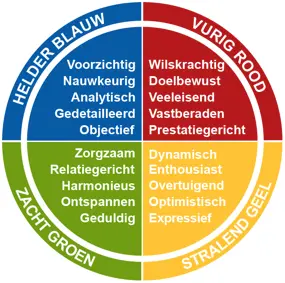
The Insights Discovery methodology uses four colors that represent the energy flows of our personality: Fiery Red, Sunshine Yellow, Earth Green, and Cool Blue. You can find these colors in all daily aspects of our behavior, as they indicate certain behavioral preferences. Everyone uses all four colors to a greater or lesser extent. To explain this color typing, here is a brief explanation of the psychological preferences according to Carl Gustav Jung:
- introversion – extraversion
This concerns the way we orient ourselves toward and respond to the outside world. People with an introverted preference tend to be more observant and reflective. They prefer to process information quietly and think before they speak. People with an extraverted preference are involved and expressive. They prefer action and discussion and like to think out loud. - thinking – feeling
This concerns the way we weigh things and make decisions. With thinking, we use a logical thought process to form ideas based on knowledge and objective facts. With feeling, we form a subjective judgment and make decisions based on our own values and the impact our decision has on others. Feeling is more people-oriented, while thinking is more task-oriented. - sensing – intuition
This concerns the way we take in and process information. Do we rely on our intuition to perceive and interpret the world, or on what we see, hear, and feel?
The preferences mentioned above do not function in isolation. The combination and intensity with which we use these preferences result in a unique personality:
- RED = extraversion and thinking “Let’s do it NOW”: determined, action-oriented, open, and direct
- YELLOW = extraversion and feeling “Let’s do it TOGETHER”: enthusiastic, stimulating, social, need for appreciation
- GREEN = introversion and feeling “Let’s do it CARINGLY”: striving for harmony, connection, respectful, and conscientious
- BLUE = introversion and thinking “Let’s do it CORRECTLY”: objective, thorough, detached, autonomy, think before acting
Real-life examples
After the theory, here is an example from practice. In these examples, you will likely recognize the language from both models.
- Someone with a preference for Red needs clear, concrete requests, which can be a challenge for someone with a lot of Green energy. The latter will more easily move toward interpretation or judgment. For example: we had an appointment scheduled, but I forgot it. A colleague with Red as their lead color will likely address me directly and ask why I wasn’t there and when we can reschedule. Someone with a lot of Green energy will first go through an internal process, where interpretations like ‘she doesn’t think it’s important’ or ‘she doesn’t like me’ will more easily linger.
- For someone with a lot of Yellow and Green in their profile, connecting with the person is important at the start of a conversation: “How are you?” Someone with a lot of Blue energy has less need for this and is therefore not as strong at small talk. It is also best to provide feedback differently to someone with Blue as their lead color than to someone with Yellow. For the former, facts or objective observations are important. For the latter, feelings and needs are paramount. For someone with Green as their lead color, a connecting request is essential: “How does it affect you to hear me say that?”
Are you curious about your unique color mix, do you want more insight into team dynamics, or do you want to strengthen yourself as a leader? Please contact us; Walk Your Talk is happy to help you!