Know that ignoring the problem is not a good idea. This can have harmful consequences. What can you do instead? We are happy to provide a few rules of thumb.
- It is not your job as a manager to resolve conflicts, but rather to create a safe context in which employees can address the conflict. Managers often become tense or paralyzed because they do not immediately know how to fix something. Letting go of that belief is an important first step.
- It is, however, your job to clearly state that you expect employees to engage in dialogue with each other. Sometimes you will need to facilitate the conversation. And in the case of escalated discussions, you will need to involve HR or an external mediator.
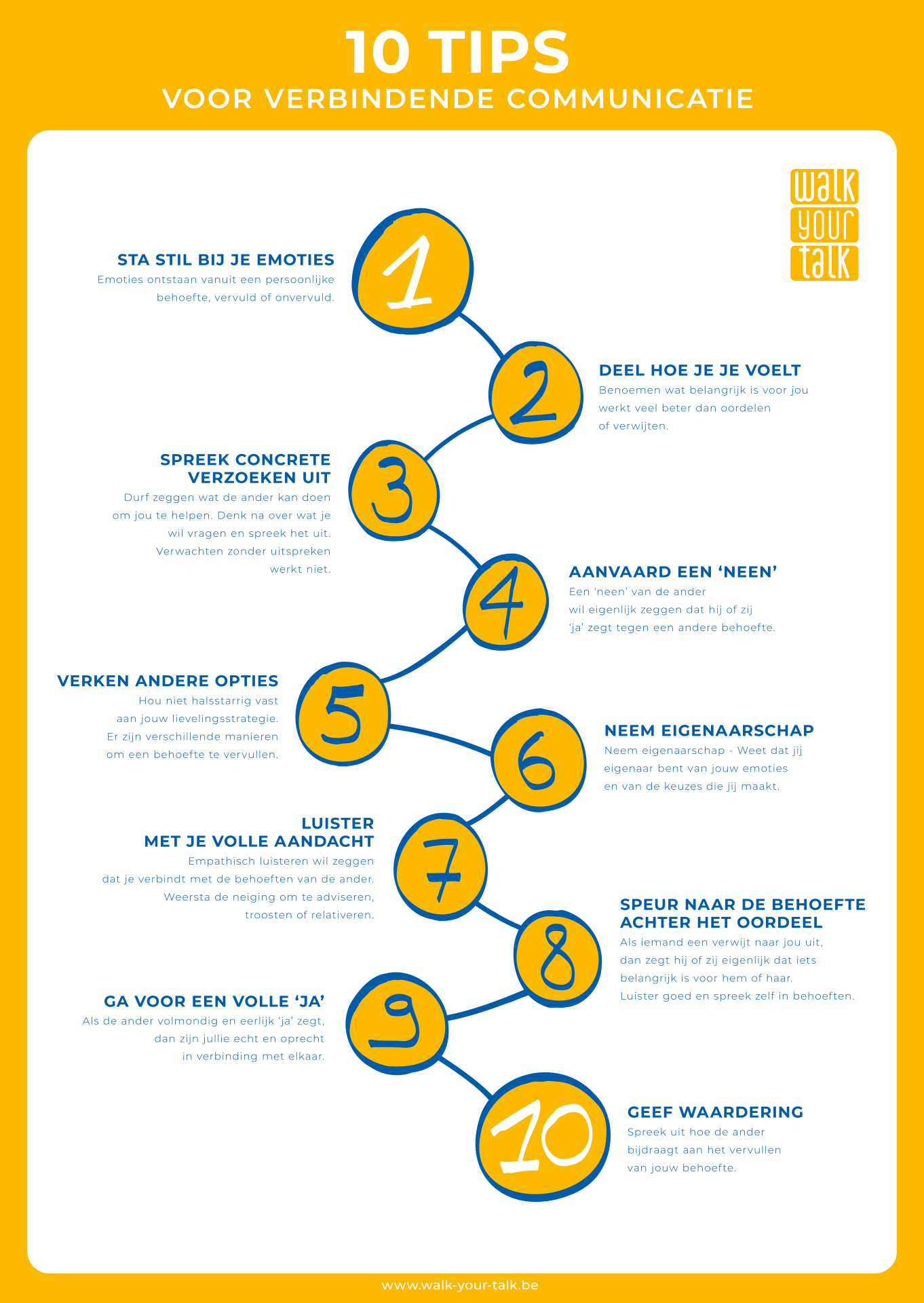
- Coach your employees and prepare for the conversation with them. The common language is connective communication. What exactly happened? What are the triggers? How does an employee feel about it? What are the underlying needs? What specific behavior would the employee like to see differently/less/more from their colleague?
- There are many models for conflict mediation. They are often based on nonviolent communication (= Connective Communication). NVC looks at conflict resolution from the perspective of needs. Needs are universal; every human being has them. This helps us connect through our shared humanity.
- Know that behind every emotion lies an important need or value. It is not about what you are doing right or wrong. Listen to what is important to the other person. A judgment or reproach is actually an unfortunate way of expressing a need.
- So, make sure you first clarify everyone’s underlying needs before looking for solutions (strategies). These solutions can result in a specific request to the other person to do something differently. Ask instead of reproaching.
- Coach your employees in empathic listening as well. Help them put themselves in the other person’s shoes. How would the other person feel about the situation? What is important to him or her? What might your colleague want to ask you?
- Follow up to see if the conversation actually took place and monitor any agreements made.
- Do not let go too quickly. In the days and weeks that follow, check whether the energy is flowing between colleagues again.
- At the same time, let time do its work. Recovery requires time and attention.