And what if a culture of openness and dialogue is not just a chapter in yet another workshop, but an attitude, a habit that you build together – step by step, in every encounter, in every conversation?
More and more organizations are looking for ways to sustainably anchor open communication in their work culture. And rightly so: it creates an environment where employees feel safe to speak up, where listening is just as important as speaking, and where trust and ownership grow. A Connecting Communication trajectory is a solid starting point for this, but the real shift? That happens afterward.
Not a technique, but a mindset
Connecting communication introduces a language that helps people understand rather than judge each other. It makes it possible to deliver difficult messages openly and honestly without damaging the (working) relationship. It invites genuine listening. But above all: connecting communication is not a trick. It is a way of working together that stems from awareness and respect for what is alive in yourself and in the other.
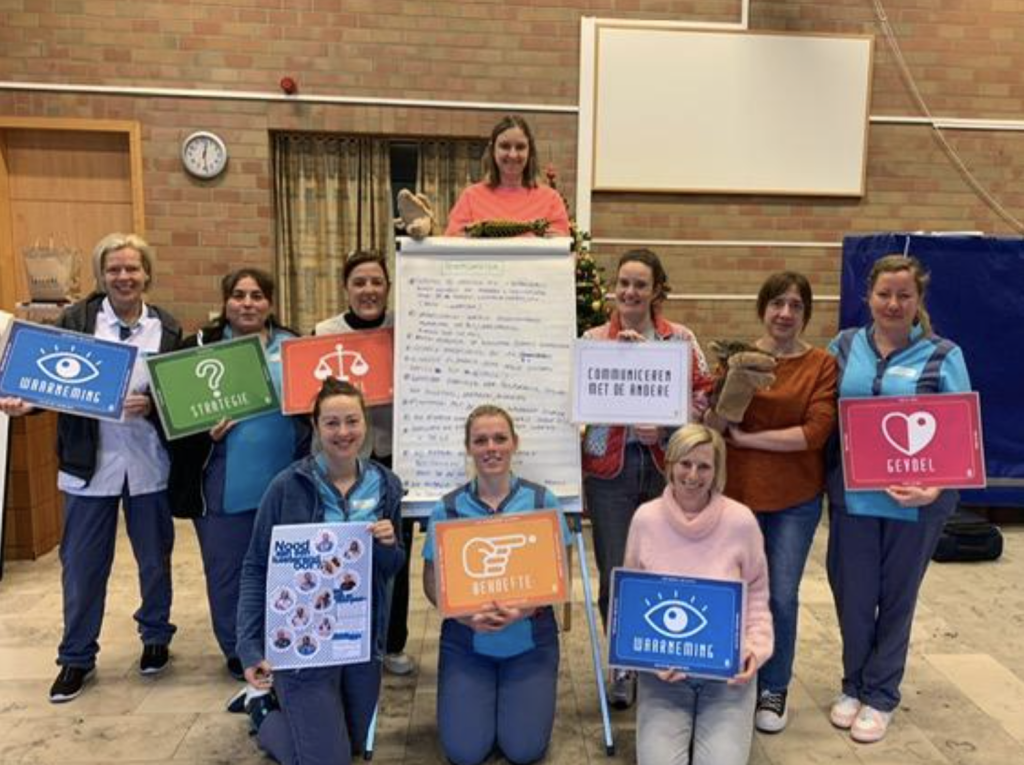
That is why in our trajectories we work not only on skills, but also on awareness and integration. We consciously slow down, take time to feel what is going on, and look together at how we can respond differently from there. When patterns become visible – both on a personal level and in teams – new possibilities emerge. True behavioral change occurs when people choose different behavior from within. Not because they have to, but because it feels right.
The leader as an example
A cultural change begins with all people, but leaders play a key role. How they communicate, listen, and respond has an impact on everyone. That is why we ask them to be the first to start working with connecting communication. They learn what this way of working means for their own style. What does it require to be truly present? How do you facilitate a difficult conversation without losing the connection?
When leaders subsequently attend the training again with their team, their knowledge deepens and their insight into the underlying team dynamics grows. What is really going on, which tensions remain unspoken, and what needs lie beneath? This makes them stronger in their role as examples. Not as perfect leaders, but as people who consciously choose openness and growth.
Ambassadors: power from within
A new culture does not emerge in a dull meeting room, but on the work floor. In how colleagues address each other, how they articulate tensions, how they listen and learn (from each other). Not top-down, then, but supported by people who believe in change.
That is why we work with ambassador programs. We guide employees who commit to keeping connecting communication alive within the organization. They come from different levels and departments, each with their own perspective. This diversity is a strength: it helps to transcend departments and bring connection between levels.
What does the ambassadors’ trajectory look like? It runs parallel to other programs and includes deepening, facilitation skills, and intervision moments. This provides them not only with the necessary tools but also the confidence to support others in conversations, team sessions, or simply through their presence.
The role is flexible. Some grow into internal trainers. Others facilitate reflection moments or support colleagues in 1-on-1 conversations. Still others are primarily visible through how they are: as a living example of what is possible. Naturally, we do not lose sight of reality in this process. An ambassador in a hospital has a different role than someone in a manufacturing company. That is why every trajectory is custom-made, tailored to the context and the people.
Ambassadors are therefore not an extension of HR or management. They are a sounding board, catalyst, and culture carrier: close by, recognizable, accessible. They know the practice, speak the same language, and sense more quickly where tensions lie and growth is possible. Organizations that embrace this build not only on sustainability but also on ownership. Because as soon as employees themselves carry the change, something fundamental arises: a culture that is not imposed, but emerges from within – with roots and wings.
Doing it yourself, growing together
Our goal? To make organizations independent of external guidance like ours. We want connecting communication to stop being a ‘project’ and become a natural part of daily collaboration.
When the language, attitude, and principles all permeate team meetings, decision-making, and performance reviews, then connecting communication truly begins to live. Then people feel heard, and teams grow in full confidence. Then leadership shifts from directing to guiding.
At the end of a trajectory, you hear the most beautiful compliment we can receive: ‘We did this together.’
Walk Your Talk naturally remains available for supervision, coaching, and intervision. We are happy to think along about how connecting communication can be given a structural place in your organization: in leadership, team development, and processes such as decision-making and co-creation.
Our work is successful when the organization picks up and passes on the connecting communication itself. Cultural change is not a quick fix; it is something you build – not in a sprint, but step by step. In every encounter, in every conversation.
And that is precisely where the power lies.